26.May
GE Vernova’s HA Gas Turbine Fleet Exceeds 4 Million Operating Hours Amid Soaring Global Energy Demand
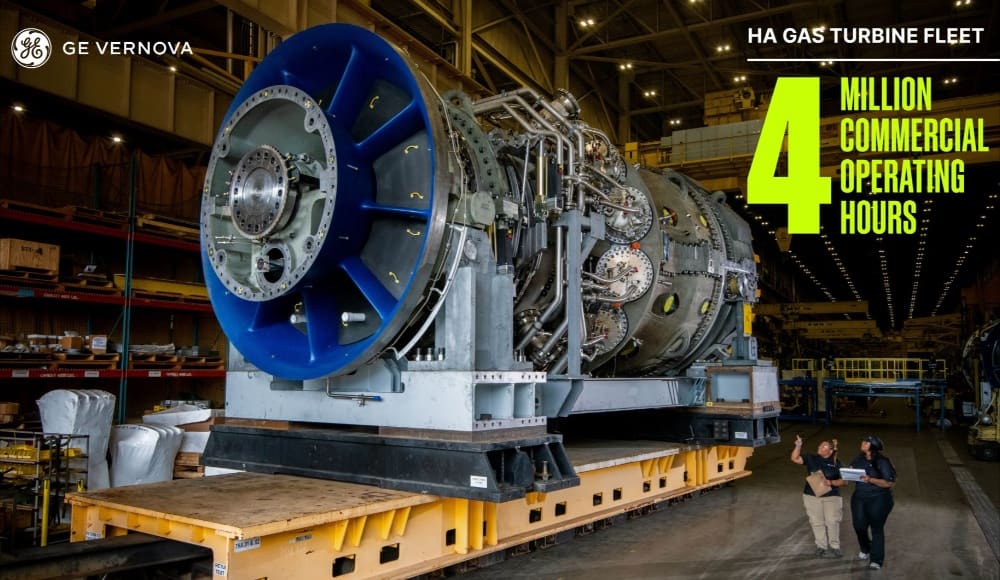
- Fleet now includes 128 units across 21 countries
- New project awards highlight the technology’s critical role in energy security, cost-effective power generation, and grid stability
- Ongoing expansion in manufacturing and service capabilities fuels future HA growth
ATLANTA, GA – (May 26, 2026) – GE Vernova Inc. (NYSE: GEV) has announced that its HA gas turbine fleet has surpassed 4 million commercial operating hours worldwide, a significant achievement for one of the most advanced and efficient gas turbine platforms in the power industry.
Since the initial HA unit began commercial operations in 2016, the global fleet has expanded to 128 units deployed across 21 nations, delivering approximately 74 gigawatts (GW) of generating capacity—enough electricity to power over 55 million average U.S. households. The HA series is now recognized as the fastest-growing gas turbine fleet in its class globally.
This milestone also underscores the increasing strength of GE Vernova’s HA aftermarket services, with nearly every newly installed turbine paired with long-term service agreements. These contracts are expanding the company’s high-value services backlog, securing revenue streams that will extend for decades.
“Reaching over 4 million operating hours is a powerful testament to the performance, durability, and strategic importance of the HA fleet in today’s evolving energy markets,” said Eric Gray, CEO of GE Vernova’s Power Segment. “This achievement reflects the trust our customers place in our HA technology and its vital function in enabling flexible, reliable power generation worldwide. As electricity demand climbs and energy resilience becomes a cornerstone of national security, clients are prioritizing solutions that deliver efficiency, dependability, and adaptability. Our HA turbines are meeting those demands today while advancing toward even lower-carbon operations in the future.”

Expanding Global Adoption of HA Technology
The HA gas turbine was engineered in response to a major transformation in the global power sector—the shift from aging coal-fired plants to cleaner, more efficient, and operationally flexible generation technologies that support renewable integration. This transition has gained urgency as rising electrification, industrial growth, and surging power needs from data centers and artificial intelligence applications place sustained strain on electrical grids.
In this context, GE Vernova continues to see strong demand for gas-based power solutions that offer scalability, high efficiency, and grid-supporting reliability. With the HA fleet growing steadily, so too are opportunities in service offerings, as operators seek to maximize performance, uptime, and operational flexibility throughout the asset lifecycle.
To meet escalating demand, GE Vernova is making strategic investments in its Gas Power manufacturing and service infrastructure, including key facilities in Greenville and Schenectady. The company plans to invest nearly $300 million in its Gas Power segment, reinforcing its ability to deliver large-scale, efficient, and adaptable power solutions. This initiative is part of a broader $700 million investment across GE Vernova to respond to record customer demand.
Recent developments further demonstrate the HA fleet’s accelerating momentum.
In the United States, the HA platform has achieved unprecedented traction. Duke Energy, for example, has ordered 20 advanced HA gas turbines, some under a framework agreement signed in 2025. Additional traditional utility customers have also committed to multi-unit HA installations. Notably, a new category of non-utility buyers—particularly data center operators, hyperscalers, and independent developers—is emerging, accounting for roughly 20% of total gas turbine contracts.
In Türkiye, GE Vernova and Enka Power have launched commercial operations at the 850-megawatt (MW) Kırklareli power plant, marking the country’s first facility powered by an HA turbine. This project brings GE Vernova’s cumulative installed gas power capacity in Türkiye to 13.5 GW.
In the UK, GE Vernova is providing a 9HA.02 gas turbine for the NZT Power project, which is set to become the world’s first full-scale gas-fired power station integrated with carbon capture technology. Construction is underway, and the turbine is scheduled to be shipped from GE Vernova’s manufacturing facility in Belfort, France, in June.