GE Vernova has secured a contract from TransnetBW to modernize the Kühmoos substation—one of southern Germany’s key grid nodes supporting cross-border electricity exchange. The project is designed to enhance system reliability and strengthen power flows between Germany, France, and Switzerland.
Upgrading a Critical Energy Hub
Located near the Swiss border, the Kühmoos substation plays a central role in regional grid stability and serves as a connection point for major pumped-storage hydropower facilities. Its modernization is part of Germany’s broader effort to reinforce transmission infrastructure in response to rising electricity demand and increasing renewable integration.
Once upgraded, the facility is expected to improve frequency control, voltage stability, and cross-border energy exchange—key factors for maintaining a resilient interconnected European grid.
Project Scope and Technology
GE Vernova’s Grid Solutions division will deliver a turnkey upgrade, including the construction of a new 380 kV gas-insulated substation (GIS). This system will replace the existing air-insulated switchgear, effectively doubling transmission capacity while reducing the physical footprint.
The solution includes:
Additionally, the project integrates a mechanical switched capacitor with damping network (MSCDN), a technology that helps regulate voltage and minimize transmission losses—especially important in high-load, renewable-heavy systems.
Strategic Importance for Europe
According to International Renewable Energy Agency projections, renewable sources could account for around 70% of Europe’s electricity generation by 2030 and nearly 90% by 2050. Achieving these targets requires not only new generation capacity but also significant upgrades to transmission infrastructure.
Initiatives like the Kühmoos modernization are critical for:
Insights from the World Economic Forum also highlight the urgency of strengthening grid infrastructure to meet rising demand and ensure stability across interconnected markets.
Industry Perspective
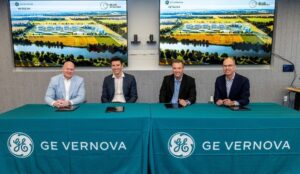
Executives from both companies emphasized the importance of the project in future-proofing the regional grid. For TransnetBW, the upgrade represents a major step toward securing reliable electricity supply in southwestern Germany and neighboring regions.
From GE Vernova’s perspective, the project underscores the company’s commitment to Europe’s energy transition and its role in delivering advanced grid technologies that support decarbonization and system reliability.
Strategic Takeaway
The Kühmoos upgrade reflects a broader structural shift in Europe’s energy system—from centralized generation to a highly interconnected, renewable-driven network. Strengthening key transmission hubs like this one is essential to ensure stable, efficient, and scalable power delivery across borders as the continent accelerates its transition to clean energy.